Showing posts with label Poppy Pouch. Show all posts

Saturday, June 11, 2022

Poppy Pouch - Finishing part 3

 It's now time to fill the inside and attach the strap. 


Making the lining:

For the lining, my teacher sent me a template.

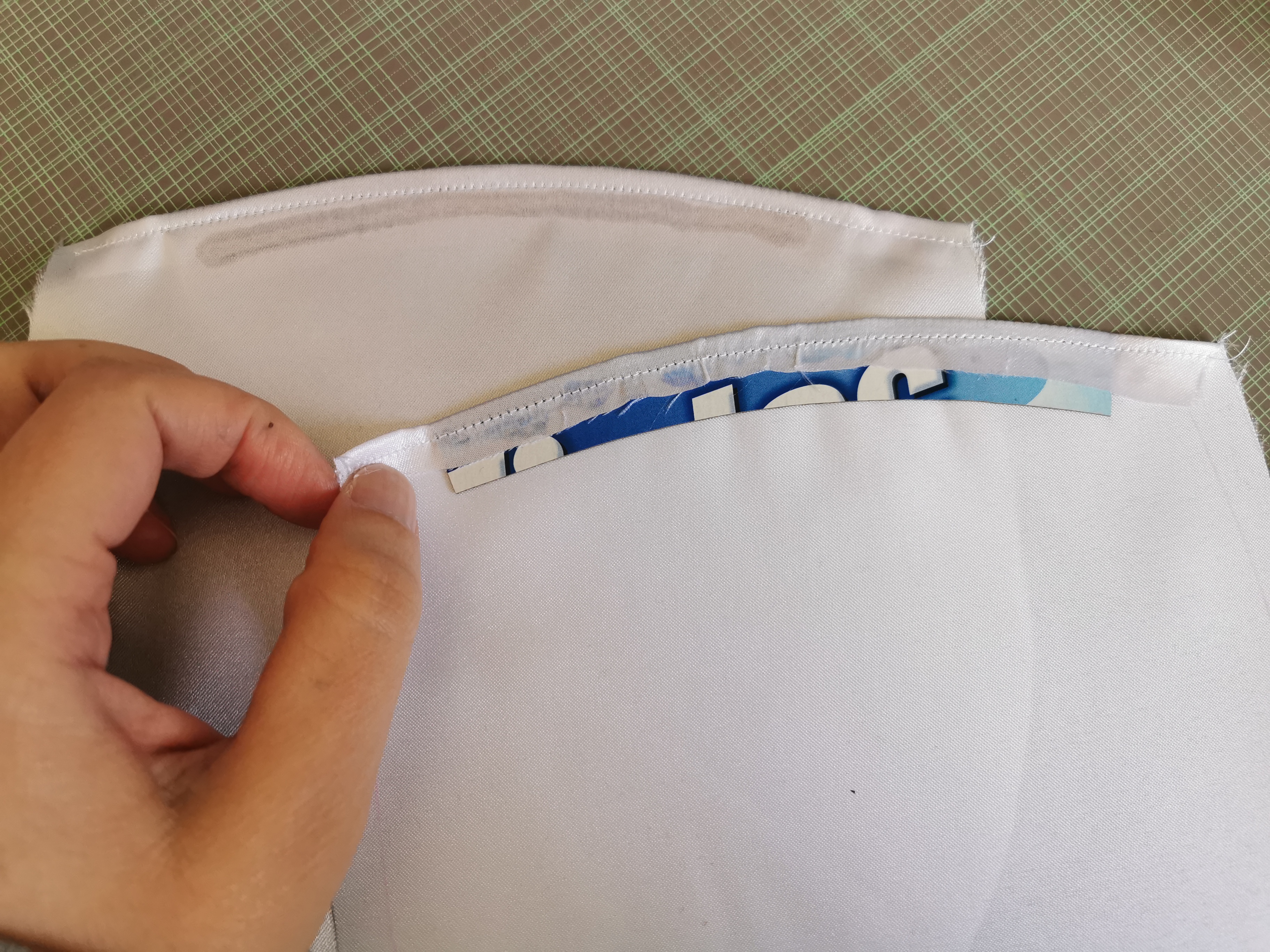
1. For this step, I needed some cardboard. I used an empty ziploc box, but if I could do it again I would use something a little thicker like a cereal box. Using the template, I traced the curve at the top but stopping 1 cm away from either side. I then drew a second curve 1.5 cm away from the first one. These two pieces of cardboard will help stabilize the edge where the magnetic clasp will be placed.


2. I used the template to trace the shape of the lining with darts. I trace a second outline around it to add a 1 cm seam allowance. This is done twice.


3. Once the fabric is cut out, glue is applied to the edge of the fabric and folded over the pieces of cardboard. Set aside to dry.

Note: If I had to do this again I would iron on a piece of interfacing on the fabric before gluing the cardboard piece. It will be clear why when you see the picture in the next step.


4. Once the glue is dry, I used a sewing machine to stitch the edge going thru both fabric and cardboard. As can be seen in the picture below, the fabric was so thin the glue is showing through to the front. Not ideal but I can get over it.

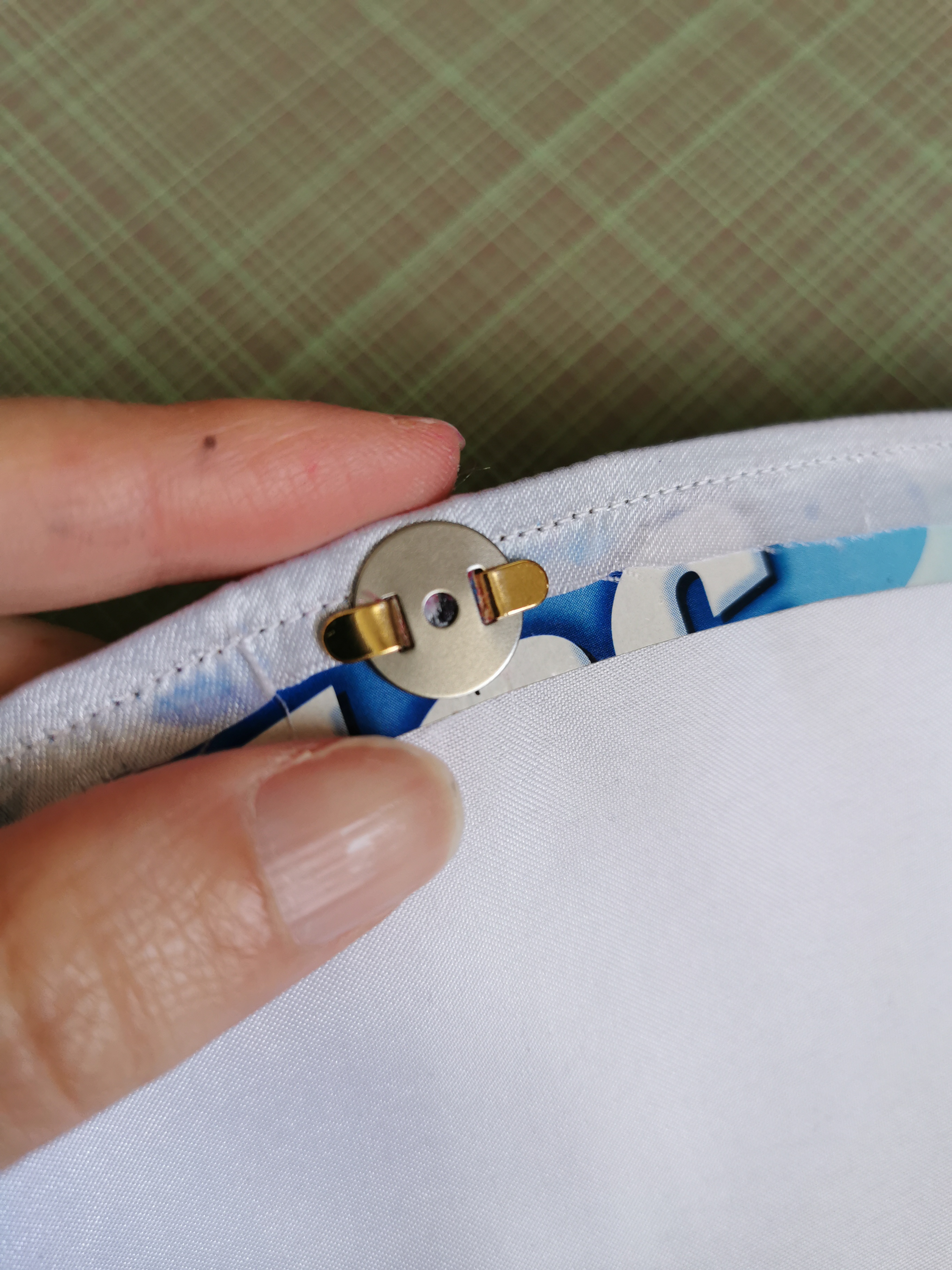
5. Now that the edge is stable, it's time to put in the magnetic clasp. The clasp is made up of 4 pieces: two make up the actual clasp and two washers that are used to keep them in place from the back. I used this tutorial to attach the clasp. First step is to find the center on the top of the opening.


I aligned the little circle of the washer to that marker and used a pen to draw in the rectangular lines. These will be the cutting lines.


Using an x-acto knife, I cut through those lines enough that I could push the prongs of the magnetic clasp through them.


Here's what the two pieces will look like when the clasps is in.


The final step was to place the washers and fold the prongs. I used a hammer to really flatten them.

6. Using the inner outline as a guide, I used my sewing machine to sew the two pieces of lining together with the outside facing in and leaving the top open.


7. The last step was to stitch the darts the same way they were done on the beaded piece.


At this point, you're going to want to check that your lining will fit in your pouch. This is also the point where you may or may not panic (like I did) when you realize that your lining might be too big for your pouch. But wait, don't panic! There's a reason that bulk is there and you don't realize it until this next part is done.


Attaching the strap:

My kit came with a white and gold cord that is used for the strap. I've seen some stitchers replace this cord with a beaded cord they made up themselves but I decided to go with what's in the kit as it's a learning piece.

1. The ends of the cord come taped to keep it from getting untwisted. Before removing it, I used a threaded needle to pierce through the cord and wrap around it. I did this a few times to keep it together. Don't end the thread yet! Once that's done, I removed the tape and untwisted the cord to flatten the ends.

2. Using the needle that is still attached to the cord, I sewed the cord to the inside of the beaded pouch. It's important to leave small stitches on the outside part of the pouch (in between the beads) so they would not be visible. Once the cord end is attached, end the thread.


3. I then glued down the end of the cords. I had some pieces of cotton laying around and I covered the glued edge with it for a clean finish. Repeat step 1-3 on the other side.


Last step, installing the lining:

I stuffed the lining into the pouch and ladder stitched it into place.


Here's what the inside looks like. Remember the extra bulk? It's just the right amount to curve over the cord.

With this ends my adventure of stitching and finishing the Poppy Pouch. I was never a fan of this design and was even adamant that I would never carry it. However, it came out beautiful and I'm especially proud of my finishing skills. So I decided that for one night I will carry this purse to a special guild event to show it off before it goes into storage. I may take it out again for a future EAC seminar, we'll see.


I have now officially completed phase 3 of Japanese bead embroidery and am already thinking of the next phase (two more to go). We're thinking fall dates, I'll have more information later. I already purchased a phase 4 kit, but I'm trying to get my hands on a different phase 4 design. I'll share a picture later if I am able to get the kit.

Friday, June 10, 2022

Poppy Pouch - Finishing part 2

In the last post, I shared how the back of the embroidery is finished off. In this post, I will show how the pouch is formed.

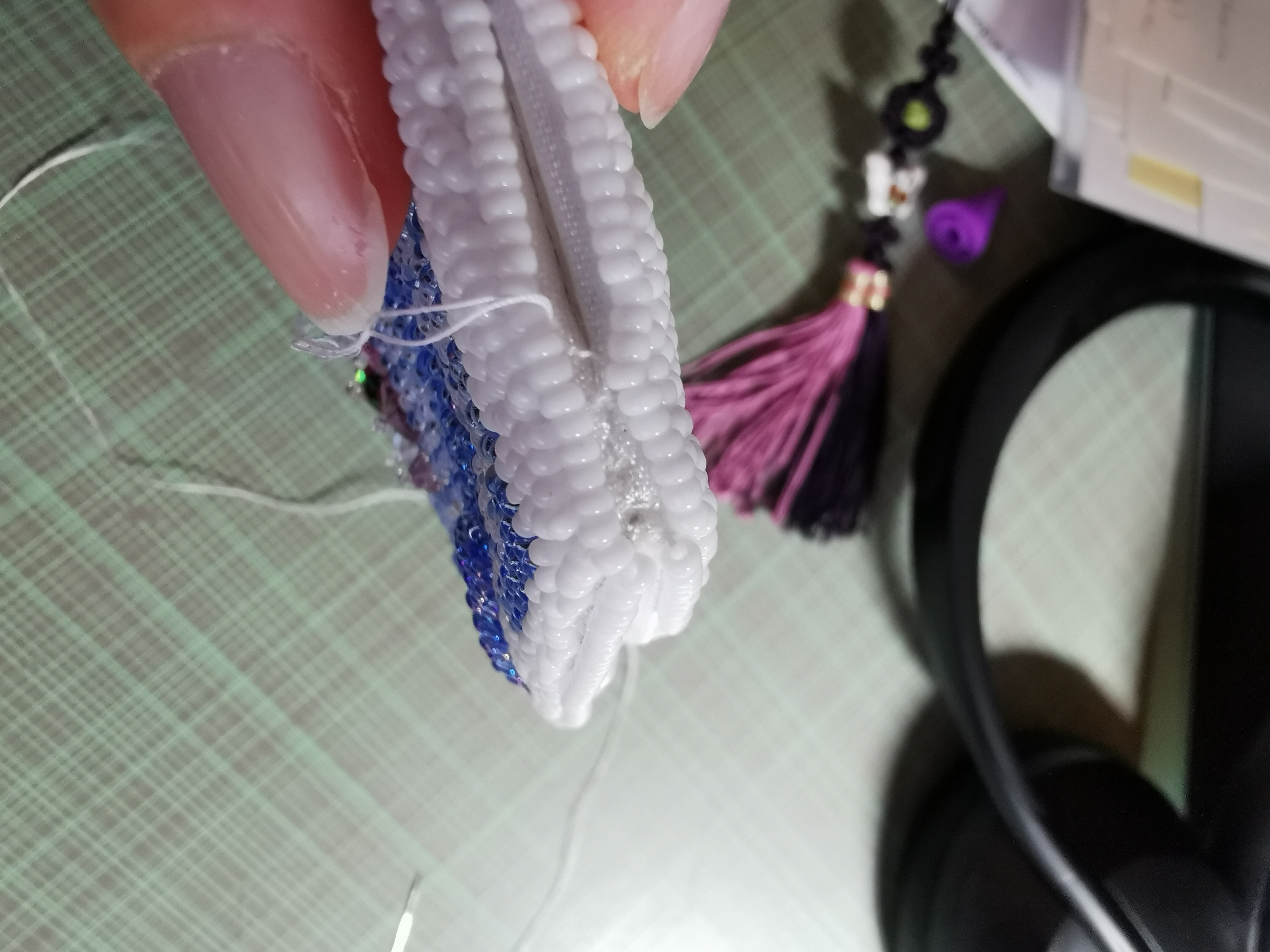
1. For sewing the darts, I used a lacing motion. Here's a video that will explain it much better than I ever could.

Once the darts were sewn shut, the pouch started to take shape. 

Here's what it looks like when one side is completed.

2. The same was repeated with the other piece.

3. The two sides are placed front side out, making sure to match the darts. I used a ladder stitch to sew them together. I tried to make smallish stitches and made sure to come up under the line of beads. It was really hard at the beginning, I have a sort of gap on mine at the top ends but it doesn't bother me too much as it's a learning piece.


I started off using a regular needled before giving up and switching for a circular needle. I should have just started with that, but I find using a circular needle awkward. However, it was really hard to stitch through the fabric with a straight needle, so it just took me a little bit more time to sew.

Here you can see the matching of the darts.


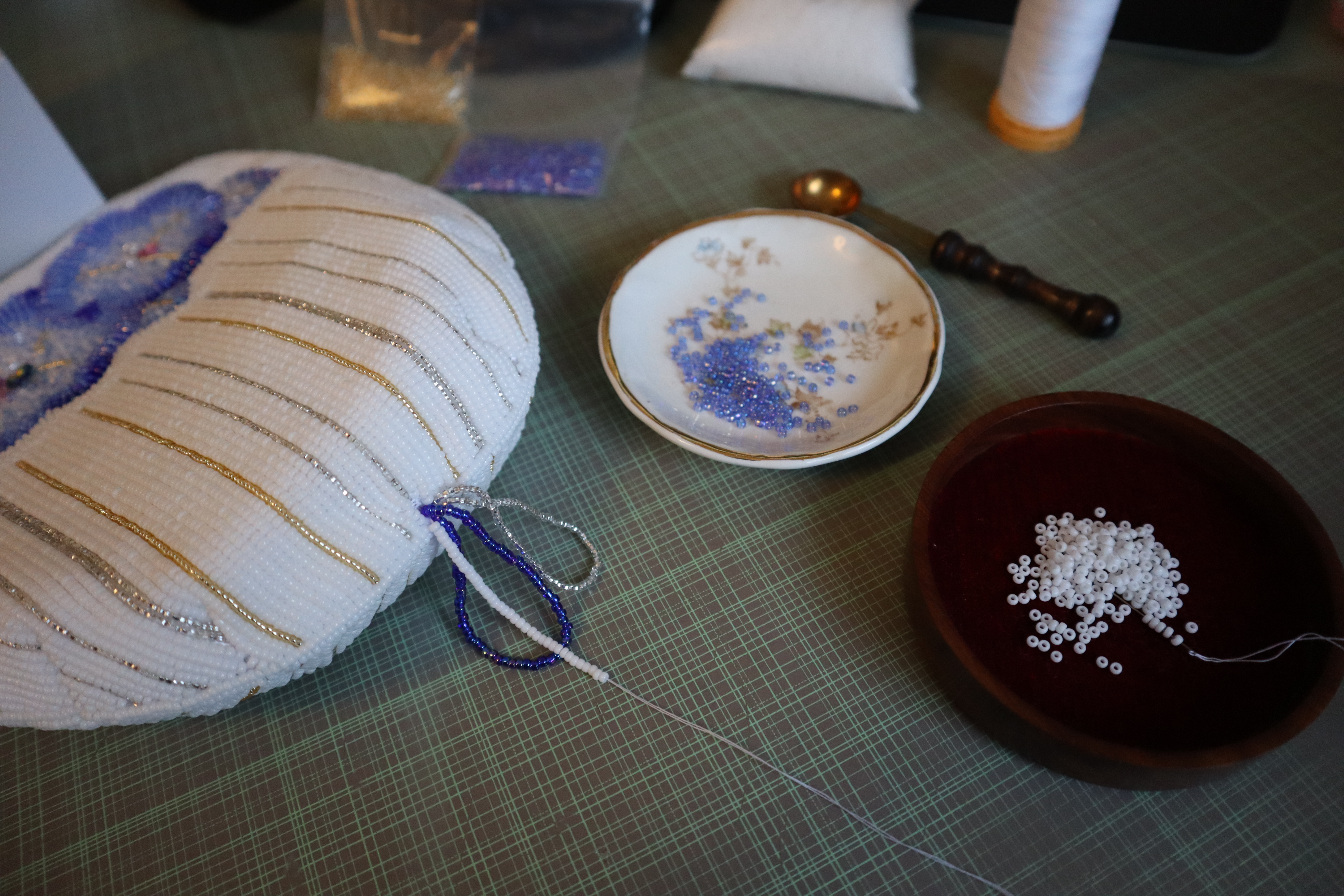
4. At the time when I discussed the tassel with my teacher, the plan was to put in the tassel when I reached the halfway point. I'm not sure what happened, if I got distracted or forgot, but I ended up doing it after I sewed the pouch. Here, I used a needle with a doubled thread. I started with a knot and a few small stitches to secure my thread and started threading beads to form the loops to make up the tassel. 

I had to do this twice as the first time, I wasn't careful and ended up with a knot inside the pouch that I couldn't find. Great it won't be visible since it's inside! What happens though, is when I pulled on the loop, suddenly the knot came undone and I had a too much thread showing. I ended up removing everything and restarting from scratch. This time going slowly and making sure to pass the needle from one hand to the other and making sure the thread is taught and has no chance of tangling.

Extra note: Each loop has about 10cm worth of beads on it before it's folded and there is a tacking stitch between each loop to ensure they are secured.

With this the outside of the pouch is completed. In the next post, I will show how I put together the lining and attached it to the pouch.

Thursday, June 9, 2022

Poppy Pouch - Finishing part 1

Today will start a series describing how I finished my bead embroidery into the pouch. I received a document from my teacher with instructions on how to do the finishing and I used my experience from past projects. I'm sharing my process in the hopes it will help other stitchers finish their own piece as not everyone is comfortable doing this type of work on their own. When I can, I will also put in notes of what to look for or things I would have done differently if I was doing this again. So let's start.


Before we can take the embroidery off the frame, we need to investigate the back.


No matter how good a stitcher you are, there is always a chance you will have loops, knots or loose threads as the cotton sewing threads tends to tangle. I looked for them and put in little pin head stitches to tack them down. It's important to be careful that the tacking stitches doesn't show at the front.


Once the back is nice and neat, l sprayed the back with water until the entire piece was wet. With my hand, I rubbed the water into the threads to make sure it's well absorbed. I then left the piece to dry thoroughly.

Note: if you do the clean up of the back beforehand, you can wet the piece early in the morning and leave it in a patch of sun. It will be nice and dry by the next day to take off the frame.


Finishing the back of the bead embroidery:

1. Before cutting out the sides, I marked the fabric, using a blue pencil, around the beaded pieces to leave a 1 cm seam allowance.

2. Once marked, each piece is cut out. Note, the darts are not cut. Not shown below (but can be seen in the next step), the curved edges are clipped about 1/2cm into the seam allowance. These cuts will help fold the edges later.


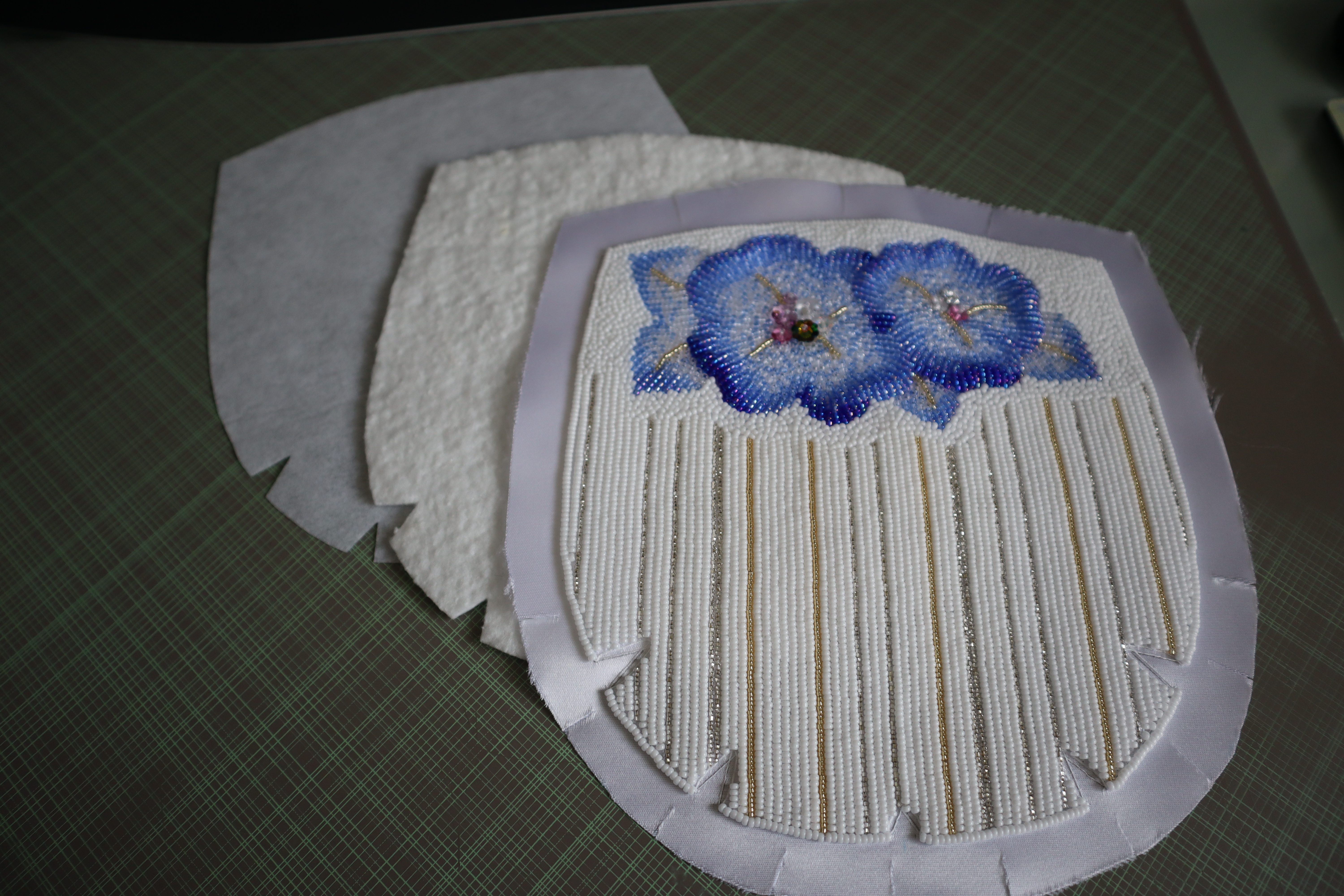
3. I used the paper pattern to cut out a piece of cotton batting and a piece of thin iron on interfacing. Two of each will be needed to complete the pouch. Note, here that the darts are cut out for the batting and interfacing. 

Note: despite the paper pattern, you want the batting and interfacing to be much smaller than the actual beaded piece. The batting takes up more space, so it should be smaller than the interfacing. This will help later to stitch the darts.


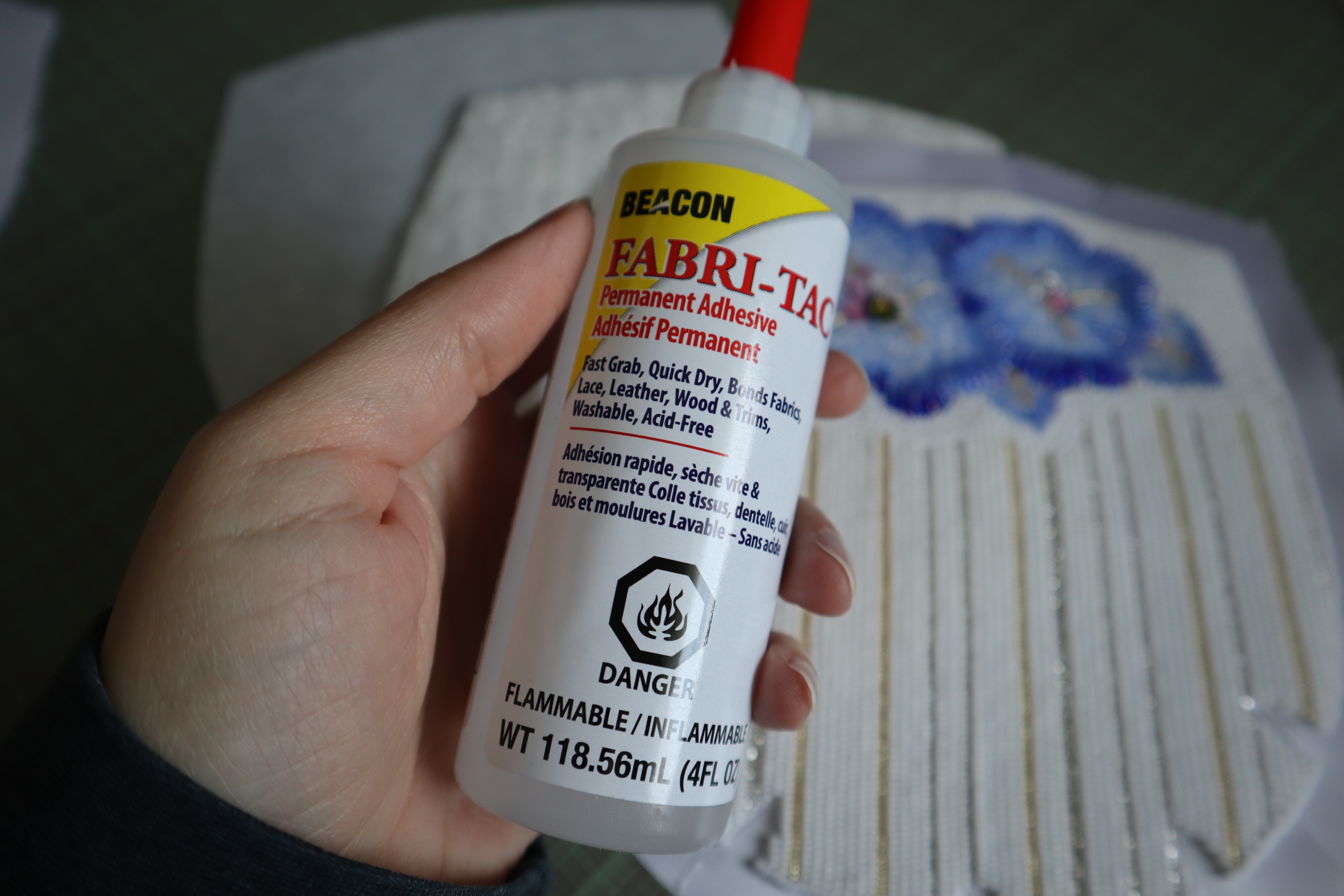
4. In this step, I used fabric glue. I placed the batting on the back of the beaded piece and applied glue to the edge of the seam allowance. The edge was folded inwards, making sure the fold is as close to the beading as possible. We shouldn't see the fabric from the front. I used fabric clips to and set it aside to dry.

Note: whenever applying glue, try to keep it to the edge. If there is any glue near the fold, it will make sewing through the fabric harder when putting the sides together.


Here are some things to look for in a glue:
  • it has to dry clear
  • it needs to be flexible when dry
  • look for acid free, which is not the same as non-toxic. Acid free means it will not yellow with age
  • I've used craft glue in the past, book binding glue, if you can find it, has all the qualities I noted above
5. Once the glue dried (this particular glue dries fast), I took out the clips and ironed the back to press the edges down.


6. The last step to finish the back of the bead embroidery, is ironing the interfacing. This not only gives the embroidery body, but "seals off" the entire piece.


Both sides are treated the exact same way. In the next post, I will show how the darts are sewn and the two sides stitched together.

Friday, April 1, 2022

Poppy Pouch - Stitching Finished

 The last time I shared pictures of Poppy Pouch, I was halfway through each piece.


I made a commitment to myself to complete all the previously covered techniques before our fifth lesson. This went by surprisingly well. It really helped to have one side completed to use as a reference.


The last technique we had to cover is the seed bead effect. It's the same one we did in Calm Flow. You remember, the part that took FOREVER to finish? Luckily for me, this time arround the areas to fill in are not only smaller, but we get to stitch with two beads at a time. Score!


I tried to make an effort not to pack in my beads, so the little gaps are normal. Packing too much is something that I'm always working on.


Stitching with two beads, I made quick work of filling the areas and managed to finish both over the same weekend.


I was super happy that I managed to finish the embroidery before the end of the class. In the sixth lesson, which happened last weekend, we covered the finishing instructions. I've gathered all my materials and am hoping to get around that this weekend. It all depends on whether I finish my homework. More on that next week.